 Linkfa
What Google Ads Costs in Nigeria and How to Budget for It
Google Ads in Nigeria has no price list. You set a daily budget, Google charges you per click, and the click price depends on what you bid on and who else wants the same searcher.
The first surprise for many business owners is the size of the bill. When clients ask Linkfa to manage their Google Ads, many expect to hear something like ₦5,000 for a campaign. Part of our job is explaining that ads cost real money, that the ad spend goes to Google and is separate from our management fee, and that a test needs enough budget to learn which keywords work.
What a click costs in Nigeria
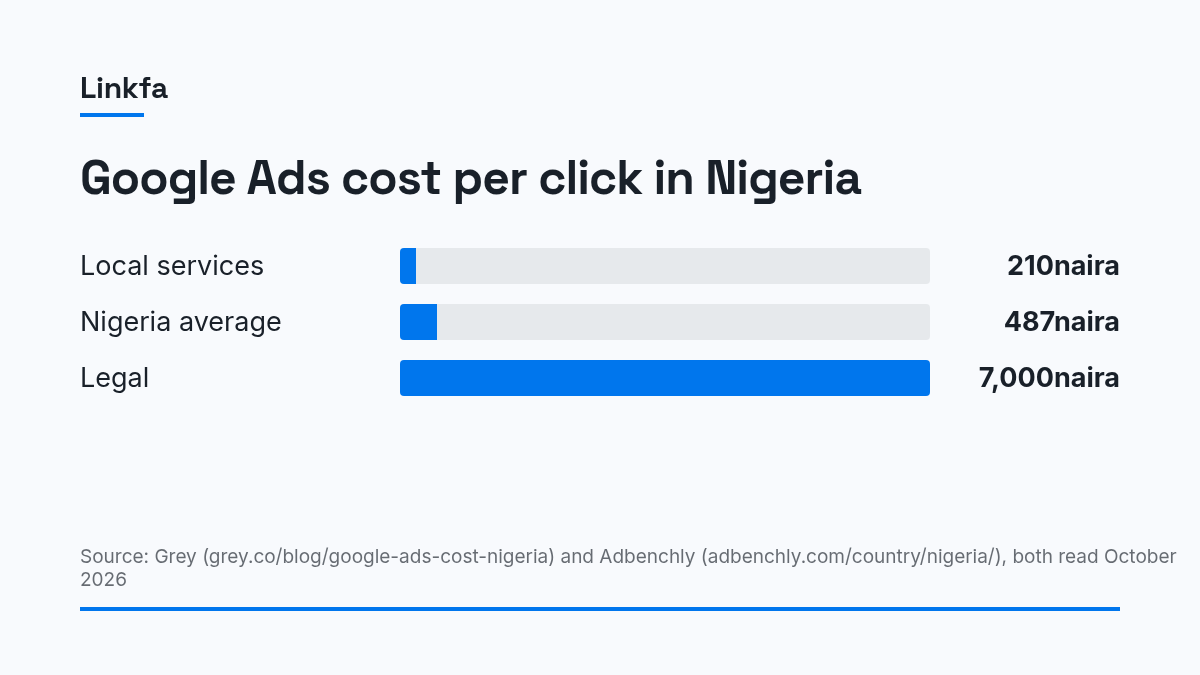
The published benchmarks disagree, and the gap is useful. Adbenchly puts the average cost per click across all industries at ₦487, and labels its figures as modeled estimates rather than measured data. Grey's guide to Google Ads costs in Nigeria gives its click prices in dollars, from $0.15 for local services to $5 for legal work. At the guide's rate of about ₦1,400 to the dollar, that is roughly ₦210 to ₦7,000. Grey also calls Nigeria one of the cheapest markets globally.
So a cheap click in one industry and an expensive click in another can differ more than thirtyfold. Any page promising one fixed Google Ads price for Nigeria is guessing.
Why the price moves
Google Ads is an auction. Each time someone searches a phrase you bid on, Google runs an auction among the advertisers who want that phrase, and the winner pays roughly what it takes to stay ahead of the advertiser below.
Your competitors set the price far more than Google does. If three Lagos law firms all want "business lawyer Lagos", they bid each other up. If nobody else wants your phrase, you can buy it cheaply. That is why legal work sits at the top of Grey's range and local services at the bottom.
The intent behind the keyword matters too. "Buy inverter Lagos" is worth more to an advertiser than "what is an inverter", because the first searcher is ready to spend, so more advertisers compete for it.
Your industry sets the baseline. Adbenchly's industry table puts legal work at ₦1,680 per click, far above its ₦487 average.
Your own ad can lower the price. Grey's guide explains that Google charges what you need to hold your position, worked out from the ad below yours and your Quality Score, which rates how relevant your keyword, ad and landing page are. A better score means you pay less for the same position, so a badly written ad costs more than a good one.
The ad spend and the management fee are two different bills
This surprises many clients. When you hire someone to manage Google Ads, you pay two separate amounts.
The ad spend goes to Google. It pays for the clicks, and it is charged to the card on your Google Ads account.
The management fee goes to whoever runs the campaign. It pays for the setup, the keyword research, the weekly checks and the reports.
A quote that mixes the two hides what you are buying. Ask for them separately, and ask how much of the monthly total actually reaches Google.
How much a fair test needs
A ₦5,000 campaign buys about ten clicks at Adbenchly's ₦487 average. Ten clicks cannot tell you which keywords bring customers.
Grey's guide says there is no strict minimum budget, and puts a realistic test at $10 to $20 a day, about ₦14,000 to ₦28,000 at its exchange rate. In its table, $300 to $600 a month is the entry testing level, where you can start to see which keywords convert.
Treat those as one source's guide, not a rule. The budget a test needs depends on your click price. A business whose clicks cost ₦300 learns faster on the same money than one whose clicks cost ₦1,500.
Two habits make a test worth the money.
Give it time before judging it. Grey's guide says a campaign takes two to four weeks to exit Google's learning period, and four to eight weeks to give reliable data on which keywords win. A few days of results are mostly noise.
Judge it on cost per customer. A ₦900 click that brings a customer is cheaper than a ₦200 click that brings nobody.
Working out a budget from your own numbers
The useful question is what a customer is worth to you. The click price comes second.
Here is a worked example with made-up figures. A customer is worth ₦80,000 to a business over their lifetime, and one in twenty people who contact it become customers. That makes a contact worth ₦4,000. If the landing page turns one visitor in ten into a contact, a visitor is worth ₦400. The business can pay up to ₦400 per click and break even, and should aim to pay less to make a profit.
Run the same arithmetic with your own figures before you set a budget. A business that does not know what a customer is worth cannot tell whether ₦500 a click is a bargain or a disaster.
Where the money leaks
Grey's guide lists the common mistakes Nigerian advertisers make. These are the ones that waste budget fastest.
Missing negative keywords
Grey calls this the most expensive mistake in Google Ads. Without a list of terms you never want to appear for, you pay for job seekers, students and people looking for something free. Read the search terms report every week and add negatives.
Broad match without controls
A broad keyword lets Google show your ad for searches related to your phrase. Grey warns that broad match with no negatives is the fastest way to burn a whole budget in a week. Start narrower.
Sending every click to the homepage
An ad for one service should land on a page about that service. Grey's example is a "buy generator Lagos" ad that should land on a generator page.
Slow pages on mobile
Grey says over 80% of Nigerian Google searches are on mobile. A landing page that loads slowly on a phone loses visitors you have already paid for.
Paying for Google Ads from Nigeria
Grey's guide says Nigerian Google Ads accounts bill in US dollars only, with no naira option, and that 7.5% VAT has applied to Nigerian ad spend since April 2022. In practice that means a card that pays in dollars, such as a virtual dollar card from a fintech or a bank card that supports foreign currency payments.
Keep the card funded and watch the payment date. If a payment fails, Google can stop showing your ads until it is fixed, and a long pause may mean the campaign has to settle again.
Managing it yourself or handing it over
Running Google Ads yourself is possible. Grey's guide budgets at least two to three hours a week for the work: reading the search terms report, adding negatives and pausing what does not work.
Handing it over makes sense when you cannot give it that time, or when the spend is large enough that a small improvement pays for the management. Before you hire anyone, ask what they charge as a fee, separate from the ad spend, and how they report results. A manager who cannot show you cost per customer is only spending your money.
Linkfa manages Google Ads campaigns for clients, and also does SEO for businesses that would rather build traffic they do not pay for per click. The two work on different timelines. Ads can bring visitors this week, and SEO builds over months.
The advertising page covers how campaigns are run, and the pricing and FAQ page answers common questions about working with Linkfa.
Book a free call with Linkfa (https://linkfa.de/talk?ref=what-google-ads-costs-in-nigeria).